
The Gentleman, the Chair, and the Frozen Aston Martin

On the morning of 4 May 1932, in the Brooklands paddock, a young man called Mortimer Morris-Goodall chopped up an official's chair, arranged the pieces beneath the oil sump of his Aston Martin, and lit them on fire.
He was halfway through a thousand-mile race.
A Race Run in Two Polite Halves
The Junior Car Club's 1,000-Mile Race was itself an exercise in compromise. The great concrete bowl at Weybridge had been hosting motor racing since 1907, but by the 1930s the leafy Surrey residents who lived nearby had grown tired of aeroplanes, racing cars, and the general racket of modernity arriving at their garden fences. Noise restrictions meant a thousand-mile endurance race could not actually be run for a thousand miles in one go. Instead, the cars would race on 3 May, park up overnight like commuters' Rovers, and resume on the 4th.
A thousand miles of racing, with a sleepover in the middle.
The race was a handicap affair, and would be won by two women. Elsie "Bill" Wisdom and the Australian Joan Richmond piloted a little 1,100cc Riley Brooklands to victory at an average of 84.41 mph, a result that period reports described as a landmark in British motoring. The Talbots, which were faster, lost on handicap.
Morris-Goodall ran as a private entrant in an Aston Martin International he had bought second-hand from Augustus "Bert" Bertelli, the company's great engineering guru. He was 25 years old and had come to the circuit with rather less interest in caution.
The Sulking Engine
Pre-war sports car engines were, in the most charitable possible description, fussy. They were hand-built from castings of questionable consistency, lubricated with oils that behaved more like treacle than fluid when chilled, and assembled with tolerances that would make a modern engineer weep into his micrometer. Start one at the optimal temperature on a summer afternoon and it would sing. Try to start one on a cold English dawn, with the oil in the sump reduced to something closer to porridge, and it would simply refuse.
On the morning of the second day, with the Aston parked up after its overnight penance, Morris-Goodall's 1.5-litre engine had decided it was having none of it.
The Fire Beneath the Sump
A sensible man would have sought a mechanic. Would have begged the pit crew for a blowlamp. Would have accepted defeat with a sigh and retreated to the paddock tea tent.
Morris-Goodall looked around, spotted an official's chair, and had what he evidently considered to be a marvellous idea.
He chopped it into pieces. He arranged the kindling directly beneath the oil sump of his racing car. He struck a match. And he stood back as a merry little bonfire flickered away under the aluminium belly of his Aston Martin, warming the oil to something approximating a temperature at which an internal combustion engine might consent to do its job.
The engine started. The Aston ran. Morris-Goodall carried on racing.
The whole business was apparently considered, by everyone involved, to be a bit of a lark.
The Man Who Chopped the Chair
Morris-Goodall was, in almost every other respect, the model of a pre-war gentleman racer. Born in 1907, educated at the proper schools, possessed of the right accent and the right tailor, he had started racing Aston Martins at Brooklands in 1929 because that is what young men of his class did when they had too much time and a functioning trust fund. He would go on to race at Le Mans ten times, compete in the Mille Miglia, and campaign at Spa. He became team manager at Jaguar when the C-Type took its first Le Mans victory in 1953, and later managed the Camoradi Maserati team, taking over at the Nürburgring from the great Piero Taruffi himself.
He was also, in a detail so extraordinary it demands a sentence of its own, the father of Dame Jane Goodall. The childhood toy chimpanzee that fixed her interest in primates, named Jubilee, came from her father. The man who set fire to furniture to warm an Aston Martin also set in motion the most influential study of chimpanzee behaviour ever conducted.
His affection for Aston Martin ran deeper than most. Having bought his International from Bertelli himself, and having been thoroughly charmed by the man who designed it, Morris-Goodall founded the Aston Martin Owners' Club in 1935. The club survives to this day. Its archives do not, so far as anyone has discovered, contain any reference to the events of 4 May.
The Genius of the Amateur
The drivers at the Surrey circuit in the inter-war years were enthusiasts with private incomes and a taste for velocity. They built their own modifications in draughty garages. They repaired their cars by the roadside with bits of wire and, on at least one documented occasion, an official's chair. They raced for the sheer hell of it rather than for any sort of wage, and the rules they followed were the rules of gentlemanly conduct rather than the rules of any particular sporting authority.
This is why a man could arrange a small open fire underneath his racing car in a crowded paddock and nobody, as far as the historical record shows, tried to stop him. The establishment trusted its chaps. The drivers, in return, generally avoided burning the place down. The system ran on mutual confidence and considerable luck, and it produced some of the most entertaining motor racing ever staged.
Morris-Goodall died in 2001, aged 94, having outlived both the era that produced him and the place that made his name. Brooklands closed to racing in 1939 and never reopened. The concrete banking crumbles gently into the Surrey ground where it was built. The Owners' Club endures.
And on a cold morning at Weybridge, on the second day of an endurance race that was being run in two polite halves, a young man with a private income and a refusing Aston warmed his engine over the burning remains of an official's chair, and went back out to finish the race.
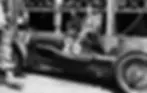
Morris-Goodall photographed at Le Mans in 1933, running car number 26, the year after the chair incident. I haven't found any photograph of him at the 1932 Brooklands race.
Footnote: The Aston Martin pictured in the main photograph is a 1.5-litre International of the type Morris-Goodall raced at Brooklands in 1932. I haven't found any photograph of his specific car at the 1,000-Mile Race.