
The Coal Scuttle That Became Aston Martin
The most glamorous badge in motoring, the one bolted into countless James Bond films since 1964, began life bolted to a machine so hopelessly unlovely its own builders named it after the thing you shovel coal with. Aston Martin was not born from a brilliant masterplan of cinematic espionage or aristocratic luxury. It was born because a wealthy motorist failed to pay a speeding fine, lost his driving licence, and was forced onto a bicycle.
In 1909, Lionel Martin was banned from driving. Stripped of four wheels, he took up cycling, joined the Bath Road Club, and happened to meet a pragmatically minded engineer named Robert Bamford. Bamford spent his days producing boat engines for the firm Hesse and Savory. Martin spent his time going fast and getting caught. Their friendship was forged in the saddle, but it was destined for the garage. They were a collision of inherited money and mechanical aptitude, and together they built a machine that made their name and unmade their finances.
The Kensington Cycle
Lionel Walker Birch Martin was a man whose family wealth flowed from the Cornish mining and quarrying industries. The mining money paid for the speed, and eventually, the garage. Late in 1912, he and Bamford took over Hesse and Savory's London depot. Tucked away at 12-16 Henniker Mews, just off Callow Street in the affluent environs of Kensington, they set up shop. The partnership was formally incorporated as Bamford and Martin Ltd in January 1913.
At first, they were merely agents. They made their living servicing GWK and Calthorpe vehicles, and ferrying Singer cars to buyers across southern England. But Martin was bored of selling other men's machinery. He wanted his own name on a radiator. And he wanted the car behind it to possess the mechanical purity of a Bugatti and the silent refinement of a Rolls-Royce.
His written philosophy was a mouthful: he demanded "a quality car of good performance and appearance, for the discerning owner driver with fast touring in mind, designed, developed, engineered and built as an individual." If that sounded impossibly expensive, it was.
Conquering Rothschild's Driveway
To build a great car, one first requires a reputation. In 1914, reputation was won on the hills. The Aston Hill Climb was a fiendish stretch of public road cutting directly through the Buckinghamshire estate of Alfred de Rothschild, near Aston Clinton. The course was short but brutal. It covered exactly 0.75 miles, beginning precisely twenty metres away from the 'T' junction with the B4009 Upper Icknield Way and hauling its competitors up a winding eighty-metre ascent.
On 4 April 1914, Lionel Martin threw a heavily tuned 10hp Singer up that very hill. He won. He returned slightly over a month later, on 16 May, for a meeting of the Herts County Automobile & Aero Club, and recorded a second successful run. The Singer had served them well, but Bamford and Martin were preparing to construct their own machine.
They needed a name. The decision was rooted in a mixture of romantic nostalgia and ruthless commercial pragmatism. They wanted to capitalise on Martin's hill climb triumphs, but they also needed a brand name that would appear at the absolute top of the alphabetical lists in motor catalogues, which were rapidly swelling to accommodate the expanding car market.
Martin himself explained the logic with characteristic dryness. "After reviewing all the flowers, beasts, birds and fishes that we knew, we got to place names. And as my Singer had recently scored a point or two at the Aston Clinton Hillclimb, the first part of that name was adopted with acclamation and my simple cognomen appended to it."
A Hybrid by the Fireplace
Naming the marque was the easy part. Building the vehicle required ingenuity and a fair amount of scavenging. The first bespoke Bamford and Martin car was initially nicknamed 'The Hybrid'. Instead of drafting a completely original design, the men utilised the salvaged chassis of a lightweight 1908 Isotta-Fraschini. Into this Italian framework, they dropped a Coventry-Simplex side-valve engine, displacing 1,398cc across four cylinders. To manage the power, Martin commissioned a custom transmission built entirely to his own exacting specifications.
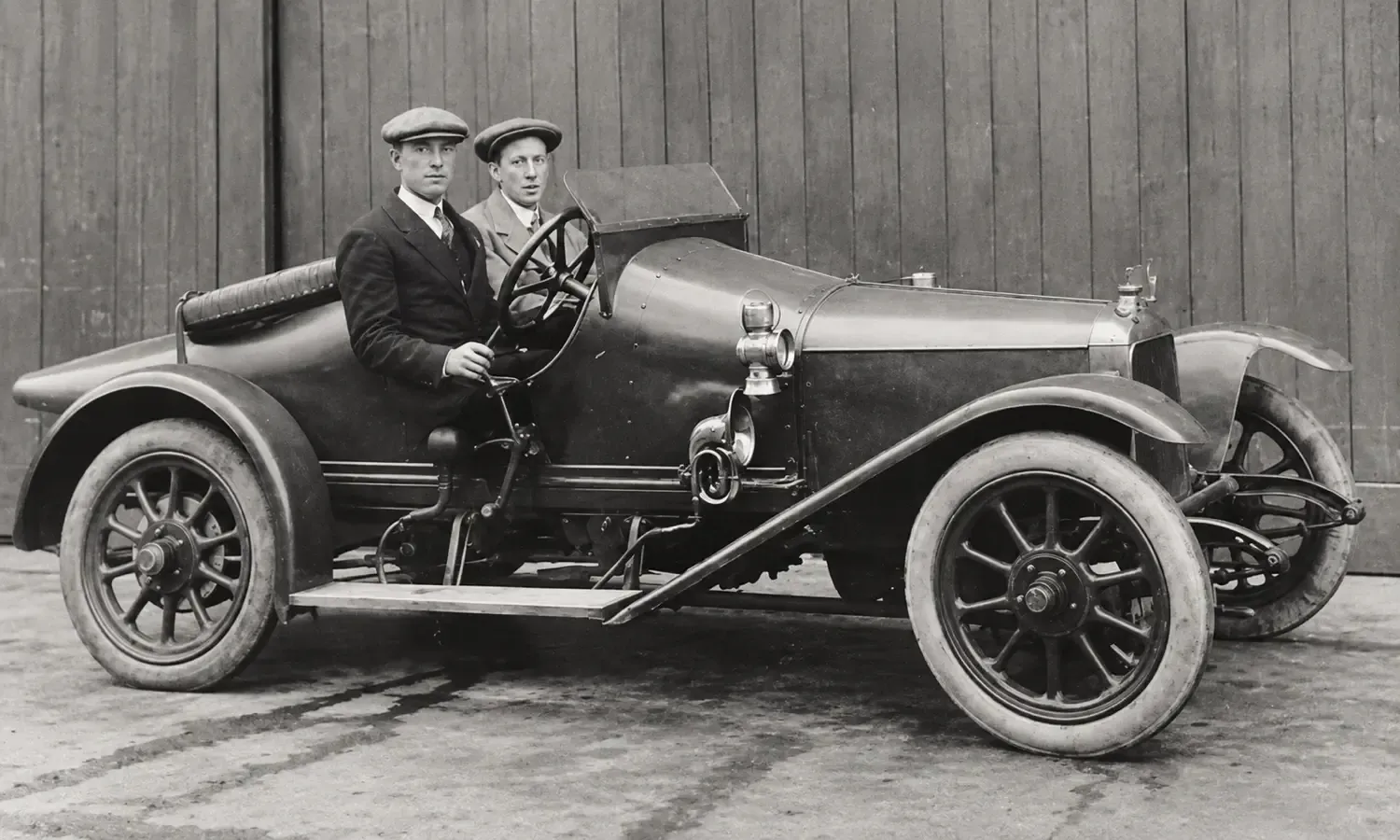
The resulting contraption was officially registered for the road on 16 March 1915. It was not a beautiful machine. Its hunched-up, utilitarian two-seater bodywork bore such a heavy resemblance to the common household tool kept by fireplaces that its first nickname was quickly discarded. History remembers prototype A1 simply as the 'Coal Scuttle'. Despite its domestic appearance, it was capable. It could haul itself up to a respectable top speed of seventy miles per hour.
The Sopwith Interruption
The Coal Scuttle proved the concept, but the First World War had terrible timing. Just a year after their initial prototype success, the outbreak of the conflict obliterated any possibility of series production. The founders traded their spanners for uniforms. Martin joined the Admiralty. Bamford enlisted in the Royal Army Service Corps.
Survival required sacrifice. To keep the dormant company financially afloat during the war, Bamford and Martin liquidated all their garage machinery, selling the entire lot to the Sopwith Aviation Company. For four years, the dream of an alphabetical motoring empire gathered dust.
The Abingdon Eviction and the Testing Director
Operations finally resumed in 1920. The firm departed Henniker Mews, relocating to new premises at 53 Abingdon Road in South Kensington. However, the partnership was fractured. Bamford, a pragmatic man who had built boat engines and serviced Singers, looked at the post-war landscape and decided he possessed little interest in the prospect of large-scale vehicle production. He abruptly resigned from the company that bore his name and sold his shares entirely to Martin.
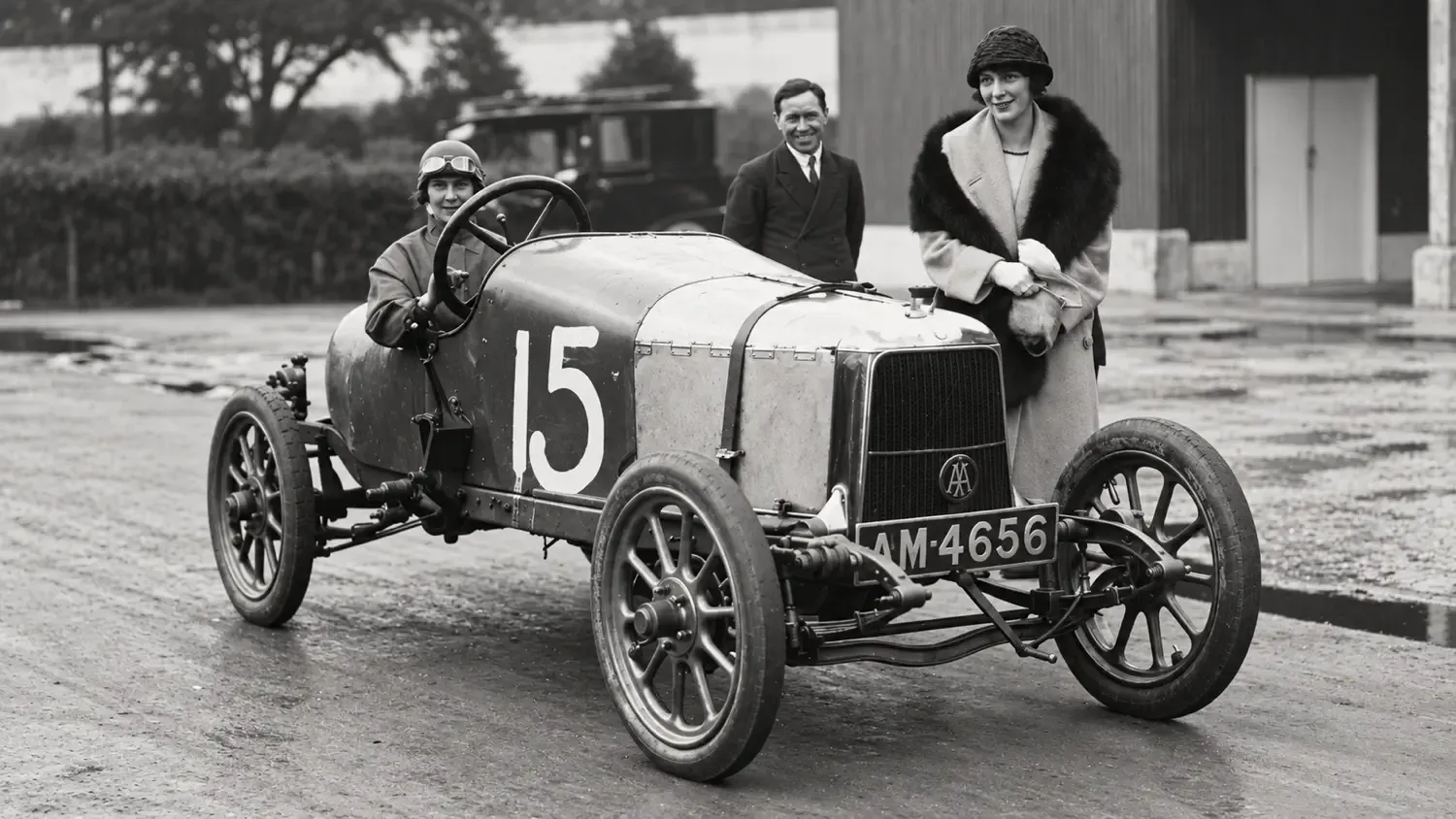
His departure left a void. Martin filled it by bringing his wife, Kate Martin, into the firm as a co-director. She was no silent partner. Kate personally assisted with the on-road testing of the new prototype vehicles. Under her watch, the company built a second prototype dubbed 'Bunny', a machine that has since vanished entirely from existence. The oldest survivor of this fragile era is chassis A3, built in 1921. Now resting with the Aston Martin Heritage Trust, it squeezed eleven taxable horsepower from its side-valve engine, which had by then grown to 1,486cc.
The Zborowski Lifeline and the Bitter End
Lionel Martin possessed a deeply romantic philosophy regarding motorsport, though his company entirely lacked the requisite funds to act upon it. The transformation of Aston Martin into a dedicated racing marque only occurred because Count Louis Zborowski arrived with a vast inheritance.
Zborowski was a wealthy amateur racer whose fortune flowed from his Astor heiress mother. He essentially adopted the struggling Kensington firm as his personal racing outfit. He poured his own money into the workshop so they could build bespoke machines for his own amusement. It was Zborowski's deep pockets that allowed Aston Martin to set ten world records at Brooklands and field highly advanced cars capable of eighty five miles per hour in the 1922 French Grand Prix.
In 1924, Zborowski had also joined the factory Mercedes team to drive one of their new two litre cars designed by Ferdinand Porsche. During the Italian Grand Prix at Monza, his car left the track and struck a tree. The crash ended his life as well as the financial lifeline keeping Aston Martin afloat. Without their wealthy patron paying the bills, the company collapsed into receivership in 1924, scraped through, and fell into receivership again in 1925.
By 1926, the situation was unsalvageable. Lionel Martin, the man who had dreamed of merging Bugatti and Rolls Royce, was forced to leave the company entirely. He died on 21 October 1945. The man whose glorious motoring empire began on a bicycle met his end after being knocked from a racing tricycle in a road collision in Kingston.
Today, an engraved stone plaque sits near the summit of the old Aston Clinton course. Placed by the Aston Martin Owners Club and Aston Martin Lagonda Limited, it overlooks a mountain bike car park. It declares the spot "The Origin of Aston Martin". It is a quiet memorial to a brilliant, chaotic partnership. Lionel Martin and Robert Bamford built their fame on a hill, salvaged a chassis to build a coal scuttle, and created a legend that outlived them both, and ruined the man who stayed.